Every UK export needs a commercial invoice, which usually doubles as a zero-rated VAT invoice. Whether you need anything else depends on one question: are you claiming a preferential (reduced or zero) import tariff under a trade agreement? If yes, that claim goes on a separate origin document, not on the invoice. This guide covers goods exports and maps your situation to the right document; services exports do not use these documents, as they carry no EORI, HS code, or origin proof and follow different VAT place-of-supply rules.
Which export document do you need?
| Your situation | Document you need | Generator |
|---|---|---|
| Shipping goods abroad (any destination) | Commercial / export invoice | Export invoice |
| You are VAT-registered and the sale needs a VAT invoice | VAT invoice, usually zero-rated for export | VAT invoice |
| Exporting to a market with no UK trade deal (US, the Gulf, most of the world) | Invoice plus VAT invoice only; standard tariff at the border, no preferential origin proof. If the buyer or a bank asks for a non-preferential Certificate of Origin, a Chamber of Commerce issues that separately. | Export invoice |
| Claiming a preferential tariff exporting to India | CETA origin declaration | CETA origin declaration |
| Claiming a preferential tariff exporting to the EU | TCA statement on origin | TCA statement of origin |
| Claiming a preferential tariff in a CPTPP market | CPTPP certification of origin | CPTPP certification of origin |
What four fields does an export invoice add?
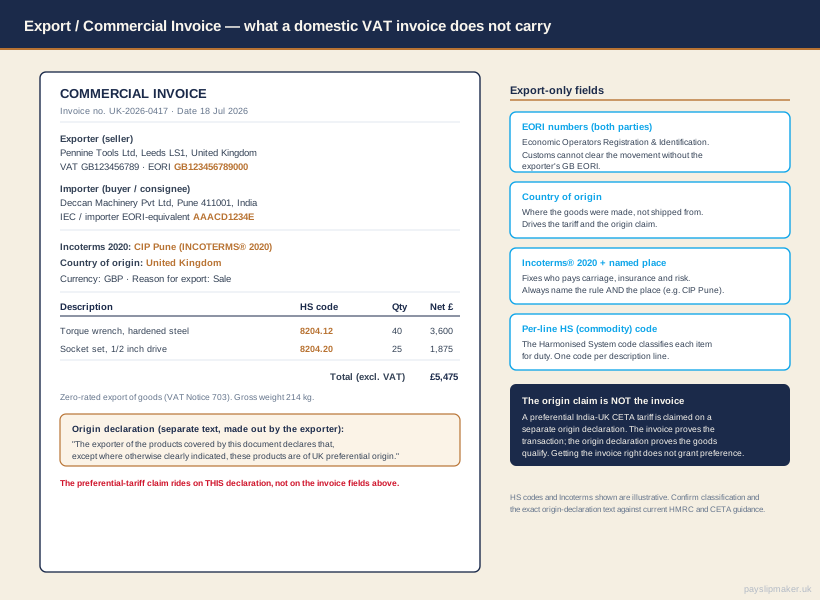
An export commercial invoice carries every field of a domestic invoice, then adds four export-only fields. The EORI number identifies the trader to customs. The country of origin states where each product was made. The Incoterms 2020 rule with a named place sets who bears cost and risk to which point. A per-line HS commodity code classifies each product for the tariff schedule.
Beyond a normal invoice, an export commercial invoice adds four fields a customs officer needs. The Export / Commercial Invoice generator has a dedicated input for each, so they are on the form rather than in a notes box.
- Your GB EORI number[2]: the reference customs uses to identify you. You need one before your first export or you cannot make the customs declaration.
- Country of origin: where each product was made, not where it shipped from. This is what an origin claim later rests on.
- The Incoterms 2020[3] rule with a named place, for example "DAP Mumbai (Incoterms 2020)": it fixes who pays freight, insurance, and duty, and to what point.
- A per-line HS (Harmonised System) commodity code: the code that sets the tariff and the rule of origin for each product line.
Do you charge VAT on exports?
Usually not: goods exported from the UK are zero-rated for VAT[1] provided the goods leave the UK within 3 months and you keep evidence of export, and Notice 703 carries the force of law on these conditions. Zero-rated means 0%, not exempt, so the sale still goes on your VAT return and you can still reclaim input VAT on related costs. Charge 0% only when you hold the export evidence, otherwise standard-rate VAT applies. Either way the invoice still needs the Regulation 14[9] fields, which the VAT Invoice generator and the Export / Commercial Invoice generator both produce.
CETA, TCA or CPTPP: which origin instrument?
| Agreement | Market(s) | Instrument | Where the claim goes |
|---|---|---|---|
| CETA | India (in force 15 July 2026) | Origin declaration (HMRC-registered template) | A separate document, sent per consignment |
| UK-EU TCA | European Union | Statement on origin | On a commercial document (may be the invoice) or by importer’s knowledge |
| CPTPP | CPTPP parties (in force for the UK from 15 December 2024, dates vary) | Certification of origin (self-certified) | A separate self-certification you complete |
Is the tariff ever claimed on the invoice?
For CETA and CPTPP, no: you register or self-certify and complete a separate origin document. Under the UK-India CETA[4] you complete the Origin Declaration Template[5] after registering with HMRC; a CPTPP claim uses a self-certified certification of origin under the CPTPP rules[8]. The EU-UK TCA[6] is the one exception: its statement on origin[7] can be written on the commercial invoice itself. For the CETA detail, see how to make a CETA-compliant VAT invoice and which goods qualify for the CETA preferential tariff.
Do you know?
Three points exporters most often get wrong:
- The invoice never grants the tariff. It records the sale; the preferential rate is claimed on a separate origin declaration, statement, or certification. Get the invoice wrong and customs clears the goods at the standard rate.
- You need a GB EORI[2] before your first export, not after. Without it you cannot make the customs declaration, so apply through HMRC before you ship.
- Country of origin is where goods were made, not where they shipped from. Imported components only repackaged in the UK usually do not make the goods UK-originating, so they may not qualify for a preferential tariff.
Primary sources
- 1.VAT on goods exported from the UK (VAT Notice 703) — gov.uk — Zero-rating conditions: goods leave the UK within 3 months, evidence of export retained (force of law)
- 2.Get an EORI number — gov.uk — A GB EORI is needed to export goods from Great Britain to any country outside the UK
- 3.Incoterms 2020 — ICC — The 11 ICC trade terms; each must be quoted with a named place, e.g. "DAP Mumbai (Incoterms 2020)"
- 4.The UK-India trade deal (CETA) — gov.uk — Official collection for the Comprehensive Economic and Trade Agreement; in force 15 July 2026
- 5.Register to complete origin declarations under the UK-India FTA — gov.uk — HMRC registration via EORI; CETA Origin Declaration Template sent per consignment
- 6.Proving originating status and claiming a reduced rate of duty (UK-EU TCA) — gov.uk — The EU-UK Trade and Cooperation Agreement statement on origin, made on a commercial document
- 7.Get proof of origin for your goods — gov.uk — Statement on origin (also called an invoice or origin declaration); the wording and where it goes vary by agreement
- 8.The UK and the CPTPP — gov.uk — CPTPP in force for the UK from 15 December 2024 (dates vary by party); self-certified certification of origin
- 9.VAT Regulations 1995, Regulation 14 — legislation.gov.uk — Mandatory contents of a UK VAT invoice
Editorial process: how we source and review UK tax content.