In sequence: identifier block (employee details, PAYE reference, tax code), gross pay, statutory deductions (PAYE, NI, pension, student loan), year-to-date cumulatives, then net pay. Section 8 of the Employment Rights Act 1996[1] makes the itemised statement a statutory right; missing any required field is challengeable at an employment tribunal. This guide walks the statement top to bottom, then covers the questions that come off it: gross versus net, benefits in kind, tax-year dates, umbrella and agency payslips, and rebuilding a lost past payslip.
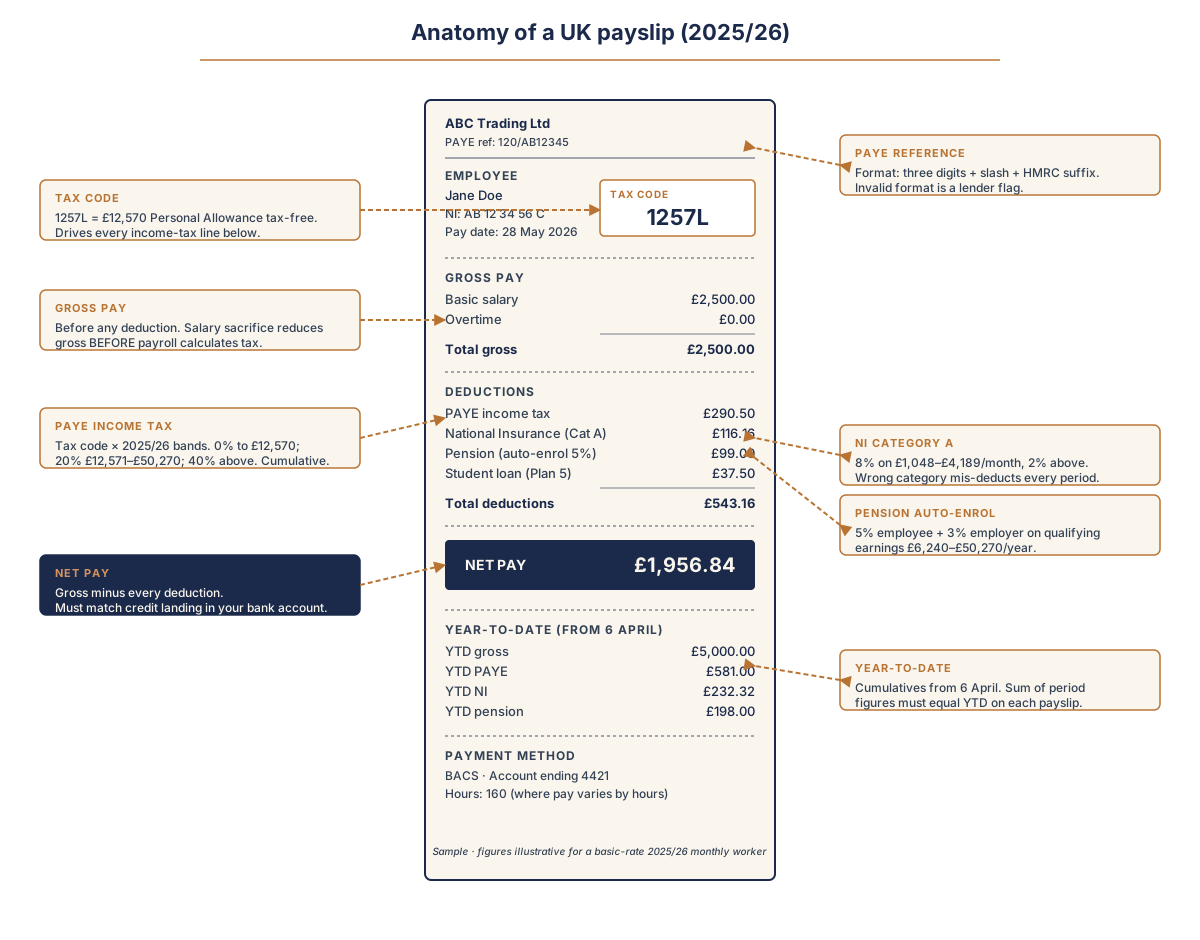
Annotated sample UK payslip for the 2026/27 tax year. The identifier block at the top carries the employer name, PAYE reference (format three digits + slash + HMRC suffix), employee name and NI number, pay date, and tax code (1257L = £12,570 Personal Allowance tax-free, drives every income-tax line below). Gross pay block lists basic salary and any overtime or bonus, totalled. Deductions block lists PAYE income tax (tax code applied against the 2026/27 bands), National Insurance (Category A: 8% on £1,048-£4,189 per month, 2% above), pension (auto-enrolment minimum 5% employee plus 3% employer on qualifying earnings £6,240-£50,270/year), and student loan (Plan 5 example: 9% above £25,000/year). Net pay equals gross minus every deduction and must match the credit landing in the bank account. Year-to-date cumulatives run from 6 April; sum of period figures across every payslip in the tax year must equal the YTD on the latest payslip.
What must a UK payslip show by law?
Gross earnings, every variable deduction (PAYE income tax, which moves pay-period to pay-period), every fixed deduction (typically pension), net pay, the method of payment, and the number of hours worked where pay varies by hours. Section 8 of the ERA 1996[1] was extended to cover workers (not just employees) in April 2019, bringing roughly 1.2 million agency workers into scope.
Which 2026/27 rates and thresholds apply?
PAYE income tax in England, Wales, and Northern Ireland: 0% on the first £12,570, 20% on £12,571–£50,270, 40% on £50,271–£125,140, 45% above. Scottish taxpayers[5] use Holyrood bands (starter, basic, intermediate, higher, advanced, top). National Insurance Category A: 8% on £1,048–£4,189/month, 2% above. Pension auto-enrolment minimum: 5% employee plus 3% employer on qualifying earnings £6,240–£50,270/year. Student loan Plan 5: 9% above £25,000/year; other plans use different thresholds. The replacement P60 guide covers how lenders verify these figures against HMRC records.
What is the difference between gross pay and net pay?
Gross pay is everything you earn before deductions; net pay is what reaches your bank after them. Section 8 of the ERA 1996[1] requires the payslip to show both, plus every deduction in between. The usual deductions that sit between gross and net, top to bottom:
- Income tax (PAYE): your tax code applied against the 2026/27 bands above your £12,570 Personal Allowance.
- National Insurance: 8% on monthly earnings between £1,048 and £4,189 for Category A, then 2% above.
- Pension: auto-enrolment minimum 5% of qualifying earnings[4], deducted before or after tax depending on the scheme.
- Student loan: a percentage of pay above your plan threshold, where applicable.
What does £30,000 gross look like after every deduction?
| Line | Rule applied | Per year | Per month |
|---|---|---|---|
| Gross pay | Contractual salary | £30,000.00 | £2,500.00 |
| Income tax | 20% on the £17,430 above the £12,570 allowance | £3,486.00 | £290.50 |
| National Insurance | 8% on earnings from £12,570 to £30,000 | £1,394.40 | £116.20 |
| Pension | 5% of qualifying earnings (£23,760) | £1,188.00 | £99.00 |
| Net pay | Gross minus every deduction | £23,931.60 | £1,994.30 |
Why are pension deductions worth a second look?
The order matters for your tax. A salary-sacrifice or net-pay pension comes out of gross before income tax is worked out, so your taxable pay, and your tax, fall. A relief-at-source pension[7] comes out after tax, with HMRC topping up the relief into the pension. Same headline 5%, different effect on net pay. This is why two people on identical salaries can take home different amounts.
Why check the year-to-date column?
PAYE and student loan are cumulative from 6 April, so year-to-date is what HMRC and lenders reconcile against, not a single month. Sum the period figures across every payslip in the tax year; the total must equal the year-to-date on your latest payslip. A gap usually means a missing or duplicated payslip, or a mid-year tax code change. How PAYE works in 2026/27 explains the cumulative calculation.
Why does the UK tax year run 6 April to 5 April?
It is fixed by section 4 of the Income Tax Act 2007[10], and the odd dates are a leftover of the 1752 calendar reform. The old tax year started on Lady Day, 25 March. In 1752 Britain dropped 11 days to adopt the Gregorian calendar; to avoid losing tax on those days the Treasury pushed the year-end to 5 April, and an 1800 adjustment moved the start to 6 April. This matters on the payslip because 6 April is the reset: your £12,570 Personal Allowance refreshes in full, year-to-date gross, tax and NI return to nil, cumulative PAYE recalculates (which is why a tax-code change often lands in April), and new Budget rates take effect.
Which tax-year deadlines should I diary?
| Date | What happens |
|---|---|
| 6 April | New tax year begins; allowances and year-to-date figures reset |
| 5 April | Previous tax year ends |
| 31 May | Deadline for your employer to issue your P60 |
| 31 October | Paper Self Assessment return deadline |
| 31 January | Online Self Assessment return and tax payment deadline |
What is a P11D and how do benefits in kind change my tax?
A P11D reports taxable benefits (company car, private medical) to HMRC by 6 July[9] after the tax year, most of them taxable under ITEPA 2003[8]. A benefit in kind is something of value your employer gives you that is not cash. HMRC usually collects the tax by lowering your tax code, not by taking it from one payslip, so a £6,000 company-car benefit shrinks your tax-free allowance and more of your salary is taxed across the year. That is why your take-home can drop even though your gross salary has not moved. Your employer also pays Class 1A National Insurance on most benefits, charged at 15% for 2026/27 on the P11D(b); you pay income tax only, not employee NI. HMRC plans to make payrolling of benefits mandatory from April 2027 (phased, starting with cars, fuel, vans and medical cover), which will replace the annual P11D for those benefits.
What counts as a reportable benefit in kind?
Common P11D items, each valued under ITEPA 2003 rules:
- Company cars and the fuel provided with them
- Private medical and dental insurance
- Interest-free or low-interest loans above £10,000
- Living accommodation provided by the employer
- Assets given to the employee, such as a phone kept personally
Do agency, umbrella, and zero-hours workers get a payslip?
Yes, all three. Since April 2019 ERA 1996 s.8[1] covers every worker, not just employees, and where pay varies by hours the payslip must also show the hours worked[13]. The payslip right is identical across the three; only the party that runs the payroll changes. The agency (or its provider) issues an agency worker's payslip; the umbrella company, which is your employer for PAYE, issues an umbrella payslip; the engaging employer or agency issues a zero-hours payslip showing the hours worked that period. Since 6 April 2020 an agency must also give you a Key Information Document before you agree terms, showing the assignment rate, deductions, and an example take-home, and your first payslip should reconcile to it.
What does an umbrella payslip look like, line by line?
| Line | What it is | Whose cost it is |
|---|---|---|
| Assignment rate in | What the client pays the umbrella per hour or day for your work | The client's payment to the umbrella |
| Employer's National Insurance | Secondary Class 1 NI at 15% on pay above the £96/week Secondary Threshold[14] for 2026/27 | Employer cost, paid from the assignment rate |
| Apprenticeship Levy | 0.5% employer levy | Employer cost, paid from the assignment rate |
| Umbrella margin | The umbrella's retained fee for running your payroll | The umbrella's charge, from the assignment rate |
| Employer's pension contribution | The employer share of auto-enrolment, where it applies | Employer cost, paid from the assignment rate |
| Holiday pay | Rolled up into your rate, or accrued and paid when you take leave | Your money, either way |
| = Your gross pay | What remains after the employer costs above are met | Yours; the taxable wage |
| PAYE Income Tax | Tax on your gross, on your tax code | Your deduction |
| Employee's National Insurance | Primary Class 1 NI on your gross | Your deduction |
| Student loan | Where a plan type applies | Your deduction |
| Employee's pension contribution | Your auto-enrolment share | Your deduction |
| = Your net pay | What actually reaches you | Yours |
Is my umbrella payslip compliant?
Employer's NI, the Apprenticeship Levy, and the employer pension are the employer's costs. Taking any off your gross, rather than the assignment rate, unlawfully shifts the employer's cost onto you. A compliant umbrella payslip passes all four:
- The assignment rate is shown at the top, not just your gross.
- Employer costs (employer NI, the levy, employer pension) sit above the gross line, met from that rate.
- The umbrella margin is disclosed as a named line, not hidden.
- Every deduction is itemised, and the top-line rate reconciles down to your gross.
What changed for umbrella pay on 6 April 2026?
The Finance Act 2026 added a new Chapter 11 to ITEPA 2003, with equivalent National Insurance rules. For payments made on or after 6 April 2026, liability is agency-first: the UK recruitment agency that contracts with the end client is now jointly and severally liable with the umbrella company for unpaid PAYE and National Insurance. Only where there is no UK agency in the chain, or the contracting party is outside the UK, does the end client carry that liability instead. To report a non-compliant umbrella, use HMRC for tax non-compliance, the Fair Work Agency for agency conduct, and Acas for a pay dispute.
Can I make a backdated or previous-month payslip?
Only to reconstruct a genuine past record from figures actually paid, such as a lost payslip. Inventing pay you never received is fraud by false representation[15], and lenders verify every figure against HMRC. Recreating a past-month payslip from figures you genuinely earned, because the original was lost or never issued, is legitimate record-keeping. Work from the real numbers: confirm the gross, tax, and National Insurance for that period against your HMRC Personal Tax Account[17] Pay and Tax History, or ask your employer's payroll, then rebuild the payslip with the correct historical date. Fabricating income does not work anyway, because a fabricated figure will not match the Real Time Information[16] feed employers already send HMRC, which is exactly the mismatch lenders catch when they verify a payslip or P60 against HMRC records. Beyond the failed application, making a false document to gain money can carry a CIFAS marker for years.
How do I check my payslip is right?
Work top down: confirm gross matches your contract and the hours shown, then check each deduction against the rules, income tax bands[2], NI thresholds[3], your pension rate and student-loan plan. Net pay should equal gross minus the lot, and must match the credit in your account on payday. If it does not reconcile, the cause is usually a wrong tax code or NI category.
In 6 steps
How to Read a UK Payslip
Work through a UK payslip in the order the figures fit together: identifiers and tax code first, then gross pay, then each statutory deduction, then year-to-date cumulatives, and finally the net pay against the bank credit.
- 1
Locate the identifier block
Find your name, National Insurance number, payroll or employee number, the employer name, the PAYE reference, the pay date, and the tax code. The PAYE reference follows the format three digits, a slash, then a suffix issued by HMRC. The tax code drives every income-tax figure below.
- 2
Read the gross pay section
Gross pay sums basic salary, overtime, bonus, allowances, and any taxable benefits. Salary sacrifice for pension or childcare reduces the gross before payroll calculates tax. Confirm the gross matches your contract and the hours shown, where pay varies by hours.
- 3
Check the PAYE income tax deduction
Apply the 2026/27 bands to the gross above your Personal Allowance: 20% on £12,571–£50,270, 40% on £50,271–£125,140, 45% above £125,140. Scottish taxpayers use Holyrood bands. PAYE is cumulative across the tax year, so the figure smooths out earnings spikes.
- 4
Verify the National Insurance category and contribution
Category A is the default. Category M applies to under-21s, Category H to apprentices under 25, Category C to employees over State Pension age. For 2026/27 Category A pays 8% between the Primary Threshold and Upper Earnings Limit, then 2% above. A wrong category over- or under-deducts every pay period until corrected.
- 5
Confirm pension and student-loan deductions
Auto-enrolment minimums for 2026/27 are 5% employee on qualifying earnings between £6,240 and £50,270. Student-loan deductions depend on the plan: 9% above the Plan 1, 2, 4, or 5 threshold, 6% above the Postgraduate threshold. Both can stack.
- 6
Reconcile year-to-date cumulatives and net pay
Year-to-date figures should equal the sum of period figures across every payslip from 6 April. Net pay must equal gross minus every deduction shown. The net figure must also match the credit landing in your bank account on payday, within a small tolerance for split payments or sacrificed benefits.
Primary sources
- 1.Employment Rights Act 1996, Section 8 — legislation.gov.uk — Statutory right to an itemised pay statement, extended to all workers in April 2019
- 2.Income Tax rates and Personal Allowances — gov.uk — 2026/27 PAYE bands and Personal Allowance
- 3.National Insurance rates and categories — gov.uk — 2026/27 employee and employer NI thresholds
- 4.Workplace pensions: what you, your employer and the government pay — gov.uk — Auto-enrolment minimum 5% employee on qualifying earnings £6,240–£50,270
- 5.Income Tax in Scotland — gov.uk — Scottish Income Tax bands applied to payslips of Scottish taxpayers
- 6.Repaying your student loan: what you pay — gov.uk — 2026/27 student loan repayment thresholds and rates by plan
- 7.Tax relief on private pension contributions — gov.uk — Net-pay and relief-at-source arrangements affect taxable pay differently
- 8.Income Tax (Earnings and Pensions) Act 2003 — legislation.gov.uk — ITEPA 2003 — the charge on employment benefits in kind
- 9.Expenses and benefits for employers: deadlines — gov.uk — P11D and P11D(b) due 6 July following the tax year
- 10.Income Tax Act 2007, section 4 — legislation.gov.uk — Defines the income tax year as 6 April to 5 April
- 11.Self Assessment tax returns: deadlines — gov.uk — 31 October paper and 31 January online filing deadlines
- 12.P45, P60 and P11D forms: P60 — gov.uk — Employer must issue a P60 by 31 May after the tax year ends
- 13.Payslips: employer guidance — gov.uk (Acas) — Who must receive a payslip and the requirement to show hours where pay varies
- 14.Rates and thresholds for employers 2026 to 2027 — gov.uk — Employer NI at 15% above the £96/week Secondary Threshold, and the 0.5% Apprenticeship Levy
- 15.Fraud Act 2006, Section 2 — legislation.gov.uk — Fraud by false representation; making a false document to gain money is an offence
- 16.PAYE and payroll for employers: Real Time Information — gov.uk — Employers report each pay period to HMRC in real time, so past figures are on record
- 17.Personal Tax Account — gov.uk — HMRC Pay and Tax History confirms the genuine figures for a past period
Editorial process: how we source and review UK tax content.