Ask the employer first; most reissue, though Regulation 67 of the PAYE Regulations 2003[1] only requires issuance once. For the current and four previous tax years, the HMRC Personal Tax Account[3] holds the same RTI figures the employer reported. For older years, ask HMRC for a Statement of Earnings letter.
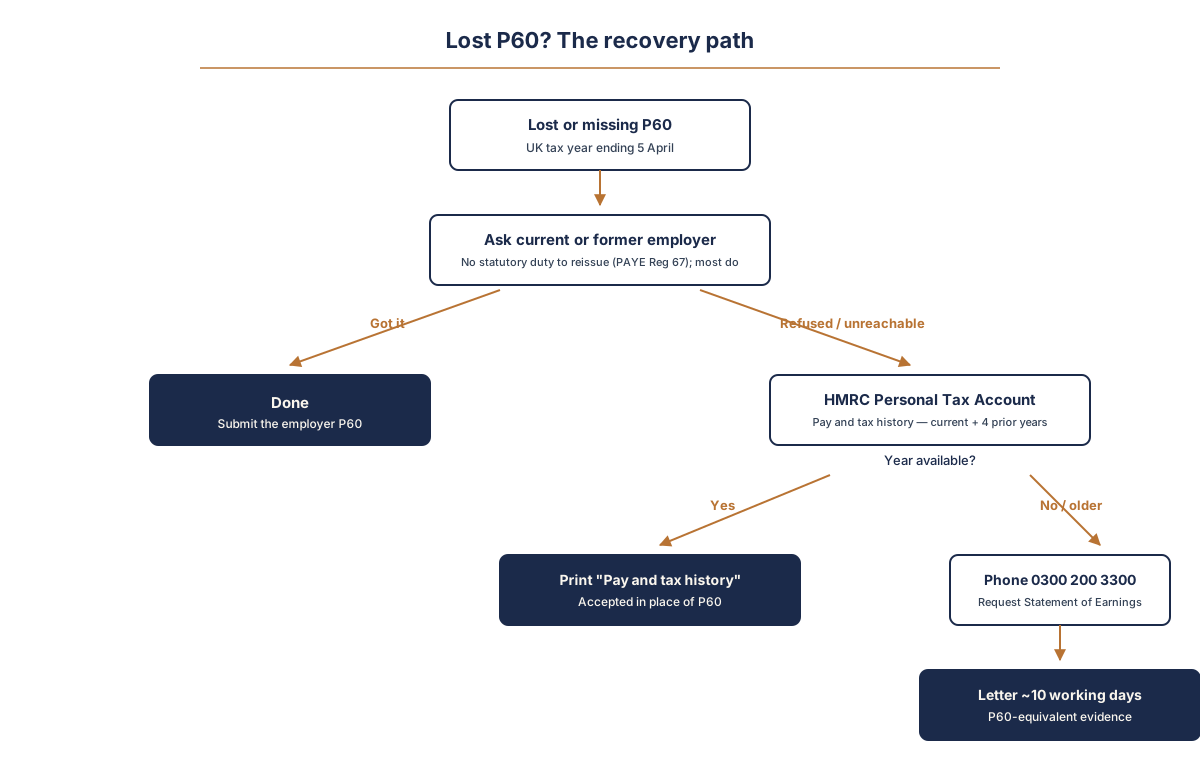
Decision tree for getting a replacement UK P60. Step one: ask current or former employer. If they refuse or are unreachable, use the HMRC Personal Tax Account, which holds Pay and Tax history for the current and four previous tax years. If the year is older or unavailable, phone HMRC on 0300 200 3300 to request a Statement of Earnings letter, which arrives in about ten working days and is accepted in place of the original P60.
What is on a P60 and when should I have one?
A single-page year-end certificate showing total taxable pay, tax deducted, final tax code, NI contributions, and statutory payments (sick, maternity, paternity) for the tax year ending 5 April. Employers must issue it on paper or electronically to every employee still in employment on 5 April, by 31 May. Anyone who left mid-year gets the equivalent figures on the P45 instead.
When does a UK requester insist on the actual P60 form?
For mortgage applications (lenders ask for the latest P60 alongside three months of payslips), Self Assessment record-keeping, overpaid-tax claims, tax credit and Universal Credit reviews, visa applications, and proving income to a court or for child maintenance. For most other purposes recent payslips or a Personal Tax Account print-out are accepted; ask the requester whether they need the form or just the figures.
How do lenders verify a P60 or payslip?
In three layers under FCA MCOB 11.6[6], which requires evidenced rather than declared income: automated document parsing, then third-party pulls (Open Banking, HMRC RTI), then manual review. A mortgage lender does not take a P60 or payslip at face value. This matters for a replacement document: the figures on it are cross-checked, so they must reconcile with what HMRC already holds.
The three verification layers
| Layer | What gets checked | Triggers the next layer |
|---|---|---|
| 1. Document parsing | Tax-code arithmetic, NI category against the employee profile, PAYE reference format[8], year-to-date cumulatives reconciled to period figures, gross minus deductions equals net to the penny | Any single significant flag |
| 2. Third-party pulls | Open Banking[7] salary-credit match over 90 days, HMRC Real Time Information gross-pay cross-check, credit file | Multiple flags |
| 3. Manual / fraud team | Employer reference letter, accountant certificate, HMRC RTI extract, review of anything the first two layers could not reconcile | Outcome: approve, decline, or request further evidence |
What makes a P60 or payslip credible?
The same checks tell you what a genuine document has to show. A replacement is credible when it reconciles against records the lender can pull independently:
- The employer name and PAYE reference match the records HMRC and the employer already hold.
- The year-to-date figures add up: sum the period figures across recent payslips and they equal the latest displayed YTD.
- Net pay reconciles: gross minus every deduction (PAYE, National Insurance, student loan, pension) equals the net figure, which in turn matches the salary credit on the bank statement.
- The tax code, NI category and pay-period dates line up with the same figures on the HMRC Personal Tax Account.
Can I fabricate a replacement P60?
No. Mortgage lenders, courts, and HMRC verify P60 figures directly against the RTI database. A fabricated P60 (even one matching real earnings) voids a mortgage offer, can trigger a money-laundering report, and in deliberate cases leads to prosecution under the Fraud Act 2006[5]. Personal Tax Account access is free, takes about ten minutes, and is universally accepted. The same verification applies to a payslip; the SA302 article covers the self-employed alternative.
In 6 steps
How to Get a Replacement P60 in the UK
Replace a lost or never-received P60 by asking the employer first, then using the HMRC Personal Tax Account for current and recent years, or requesting a Statement of Earnings letter from HMRC for older years.
- 1
Confirm the tax year required
A P60 covers a UK tax year ending 5 April. Identify the exact year (for example, "2024/25 ending 5 April 2025") before making any request; it speeds up payroll lookup and HMRC searches.
- 2
Ask the current or former employer
Contact the payroll team and ask for a duplicate. There is no statutory duty to reissue under Regulation 67 of the PAYE Regulations 2003, but most employers do so without charge. If the company has ceased trading, skip to HMRC.
- 3
Sign in to the HMRC Personal Tax Account
Go to gov.uk/personal-tax-account and log in with a Government Gateway ID. Navigate to PAYE → Pay and tax history. HMRC shows P60-equivalent figures for the current tax year and the four previous tax years.
- 4
Save or print the Pay and tax history page
Print the page or save it as a PDF. Most lenders, courts, and government bodies accept the Personal Tax Account print-out in place of the original P60.
- 5
Request a Statement of Earnings for older years
For tax years before 2019/20, or where the Personal Tax Account is not accessible, phone HMRC on 0300 200 3300 (or write in) quoting the National Insurance number, the tax years required, and the employer name. HMRC issues a Statement of Earnings letter within around 10 working days.
- 6
Never fabricate a replacement
Mortgage lenders, courts, and HMRC verify P60 figures directly against HMRC RTI data. A forged P60, even one matching real earnings, can void a mortgage offer, trigger a money-laundering report, or constitute an offence under the Fraud Act 2006.
Primary sources
- 1.PAYE Regulations 2003, Regulation 67 — legislation.gov.uk — Employer duty to issue P60 (End of Year Certificate) by 31 May
- 2.P60 — gov.uk — HMRC overview of what a P60 contains and who must issue it
- 3.Personal tax account: sign in or set up — gov.uk — View PAYE pay and tax history for the current and four previous tax years
- 4.HMRC Income Tax: general enquiries — Phone 0300 200 3300 to request a Statement of Earnings letter
- 5.Fraud Act 2006 — legislation.gov.uk — Statutory basis for fraud offences arising from document fabrication
- 6.FCA Mortgages and Home Finance: Conduct of Business sourcebook (MCOB) — Affordability rules requiring evidenced rather than declared income
- 7.Open Banking Implementation Entity standards — Account Information Service standards used by lenders to match salary credits
- 8.PAYE reference numbers — HMRC employer guide — Employer reference format and PAYE record structure
Editorial process: how we source and review UK tax content.