UK Directors · PAYE Salary · Self-Employed Clarified · 2026/27
Do company directors get payslips?
Yes — if you pay yourself a PAYE salary through your limited company, the Employment Rights Act 1996 s.8 entitles you to a payslip. Sole traders draw profits, not wages. No employer-employee relationship exists, so no payslip is issued.
— Nothing leaves your device.
Proofread free — pay for the final, ready-to-submit PDF
Start generatingIn this section
Sole traders
If you operate as a sole trader or in a partnership, you are not an employee. Your proof of income is an SA302 tax calculation and tax-year overview from HMRC — not a payslip. Generating a payslip for sole-trader profits misrepresents the income type and tax treatment. SA302 vs P60 — which do lenders want?
Umbrella / agency / inside IR35
Workers employed through an umbrella company, on agency PAYE, or on engagements caught inside IR35 receive payslips from their umbrella, agency, or fee-payer. The umbrella or fee-payer files the Full Payment Submission and is the employer of record — you must not self-generate a payslip for this income.
Payroll
- Payslip GeneratorHMRC-aware PAYE, NI, pension, and student-loan deductions on 2026/27 rates.
- Payslip for Mortgage ApplicationLender-ready payslips for UK mortgage applications — including lost-payslip and sole-director cases.
- Payslip for Company DirectorsPayslips for limited-company directors on salary-plus-dividends, with the correct director NI method.
- P60 GeneratorEnd of Year Certificate — annual pay, tax, NI and student-loan totals on the HMRC 2026/27 substitute-form layout.
- Salary StatementManual entry for mortgage applications, loans, and visa records — you control every figure.
More generators
What this generates
- UK payslip PDF for a limited-company director on PAYE salary
- Correct director NI calculation (annual earnings period method)
- Income tax, NI category (A or M), pension, student-loan lines
- Suitable for salary-plus-dividends remuneration structures
Primary sources
Reviewed by Eleanor Whitfield · UK payroll, PAYE & National Insurance
This page is for
- Limited company directors paying themselves a PAYE salary through their own company
Not for
- Dividend-only directors (no PAYE salary)
- Sole traders and partnerships
- Umbrella company workers
- Agency PAYE workers
- CIS subcontractors
Sole trader or limited company director?
Your legal structure decides it. Sole traders draw profits from a business they own personally. Limited company directors pay themselves through a separate legal entity, as its employee.
| Aspect | Sole trader / partnership | Limited company director |
|---|---|---|
| Legal structure | Trades in own name — no separate legal entity | Employs self through a limited company — separate legal entity |
| Tax route | Self Assessment (SA100 + SA103F pages) | PAYE for salary; Self Assessment for dividends |
| Gets a payslip? | No. No employer-employee relationship exists. | Yes, for the PAYE salary — required by Employment Rights Act 1996 s.8 |
| Proof of income | SA302 tax calculation + tax-year overview from HMRC | Payslips (salary) + company accounts / SA302 (dividends) |
| NI paid | Class 4 on profits above £12,570; Class 2 now voluntary (treated as paid above the £7,105 Small Profits Threshold). | Class 1 employee NI on salary (company pays employer NI separately) |
| Mortgage income evidence | 2 years SA302 + tax-year overviews | 3 months payslips (salary) + 2 years accounts / SA302 (dividends) |
Legal structure
Sole trader / partnership
Trades in own name — no separate legal entity
Limited company director
Employs self through a limited company — separate legal entity
Tax route
Sole trader / partnership
Self Assessment (SA100 + SA103F pages)
Limited company director
PAYE for salary; Self Assessment for dividends
Gets a payslip?
Sole trader / partnership
No. No employer-employee relationship exists.
Limited company director
Yes, for the PAYE salary — required by Employment Rights Act 1996 s.8
Proof of income
Sole trader / partnership
SA302 tax calculation + tax-year overview from HMRC
Limited company director
Payslips (salary) + company accounts / SA302 (dividends)
NI paid
Sole trader / partnership
Class 4 on profits above £12,570; Class 2 now voluntary (treated as paid above the £7,105 Small Profits Threshold).
Limited company director
Class 1 employee NI on salary (company pays employer NI separately)
Mortgage income evidence
Sole trader / partnership
2 years SA302 + tax-year overviews
Limited company director
3 months payslips (salary) + 2 years accounts / SA302 (dividends)
For limited company directors on PAYE
Generate your director’s payslip below.
- Enter the salary your company pays you — the gross figure before PAYE and NI.
- The 2026/27 HMRC rates for Income Tax, NI, pension, and student loan are applied automatically.
- The employer name field is your company’s registered name. You are both the employer and the employee.
- Net pay on the slip must match the credit on your bank statement, to the penny.
RTI prerequisite
This payslip records payroll you must actually run through an HMRC PAYE scheme (RTI/FPS). Filing a Full Payment Submission is a legal requirement for each payment of salary; a lender’s HMRC cross-check will return no matching data if no FPS has been submitted. If you do not pay yourself a salary — no bank credit, no FPS filed — entering one here records nothing real and misrepresents your income to any lender, landlord, or authority that verifies it. It is not a substitute for running payroll.
Employer details
Saves your business details in this browser only — nothing is sent to any server.
Upload your own header image, footer image, and footer text. The payslipmaker.uk site-mark and default footer caption are suppressed in the PDF when this is on. Files stay on your device.
Summary
Employer pension: £0
Tax calculations are estimates based on 2026/27 HMRC rates. For exact figures, consult your payroll software or an accountant.
Step-by-step
How to Generate a UK Director's Payslip
Generate a PAYE payslip for the salary component of your director's remuneration. Enter your limited company as employer, set the gross salary your company actually pays you (not dividends), pick NI Category A (or M if under 21), and confirm the figures match your HMRC PAYE scheme records before downloading the PDF.
- 01
Enter your company as the employer
Your limited company's registered name goes in the employer field — not your personal name. You are both the employer (the company) and the employee (you personally). Use the exact name registered at Companies House; lenders search Companies House on this field as a first-pass verification check.
- 02
Enter your personal details as the employee
Your name, National Insurance number, and the tax code HMRC has issued for this employment — usually 1257L if this is your only PAYE source of income. The NI number validates against the QQ 12 34 56 A format on blur. The tax code drives every income-tax figure in the calculation.
- 03
Set the pay date and frequency
Most directors pay themselves monthly. Pick the pay date for the period you are generating — this controls the tax-year-to-date cumulative window. Four-weekly produces thirteen pay periods per tax year, not twelve; the generator adjusts YTD figures accordingly.
- 04
Enter the gross PAYE salary only
Enter the salary figure your company actually pays you — the amount agreed, credited to your bank, and reported to HMRC via Full Payment Submission. Do not enter dividends here. Dividends are not salary, not PAYE, and do not appear on a payslip; they are declared on a separate dividend voucher.
- 05
Pick NI Category A and confirm deductions
Category A is standard for most directors. Category M applies if you are under 21; Category C if you have reached State Pension age. PAYE, NI, pension, and student-loan deductions calculate automatically on HMRC 2026/27 rates. Check net pay against the salary credit on your bank statement before downloading.
- 06
Download and cross-check against your FPS
The PDF builds in your browser — no data leaves your device. Before issuing the payslip, confirm the gross, tax code, NI category, and pay-period figures match the Full Payment Submission your payroll software or accountant filed with HMRC. A payslip that does not reconcile to the FPS will not satisfy a mortgage lender or HMRC enquiry.
Updated 2026-07-03
How director pay works in 2026/27
Salary and dividends
Most owner-directors pay themselves a combination of salary and dividends. The salary runs through PAYE: the company deducts Income Tax and Class 1 employee National Insurance and remits them to HMRC each month. Dividends come from the company’s post-tax profits and are declared on a dividend voucher, not a payslip. HMRC taxes the two differently: dividend income above the £500 annual allowance (2026/27) is taxed at 10.75% (basic rate), 35.75% (higher rate), or 39.35% (additional rate) via Self Assessment — these rates increased from 6 April 2026.
The common salary strategy
The secondary threshold for employer National Insurance is £5,000 per year (£96 per week, £417 per month) in 2026/27. Paying a salary at exactly this level avoids employer NI but does not earn a qualifying year for the State Pension — the Lower Earnings Limit (LEL) for 2026/27 is £6,708 per year, and earnings must reach this figure for the year to count towards the new State Pension (see qualifying years explained). The most common owner-director approach is a salary at £12,570 — equal to the personal allowance — which eliminates Income Tax on the salary and earns the qualifying year, at the cost of employer NI on the band between £5,000 and £12,570. Employment Allowance (up to £10,500 in 2026/27) can absorb some or all of that employer NI cost — but only where at least one other employee, besides the sole director, is paid above £5,000 in the year; a company whose only employee earning above £5,000 is a sole director cannot claim the allowance. No salary level is universally correct; the decision turns on the company’s tax position, existing payroll, and advice from an accountant familiar with director remuneration.
Primary sources: HMRC NI rates & thresholds 2026/27 · HMRC CA44 — NI for company directors
What the payslip covers
A director’s payslip covers only the salary component. It shows gross salary, Income Tax deducted under the tax code HMRC has issued, Class 1 employee NI, pension, student loan (if applicable), and net pay. Dividends do not appear on a payslip. If you receive a dividend, the company produces a separate dividend voucher — a one-page document stating the date, amount per share, and total dividend paid.
National Insurance for directors
HMRC treats directors as employees for NI purposes. Most director-employees use NI Category A (standard employee rate). HMRC calculates director NI on an annual basis, not monthly. Directors who pay a low salary early in the year and a larger sum later will face a heavier NI bill in the final months. The annual earnings period closes the gap that would otherwise let directors split salary unevenly to avoid per-period NI thresholds.
The document
What appears on a director’s payslip.
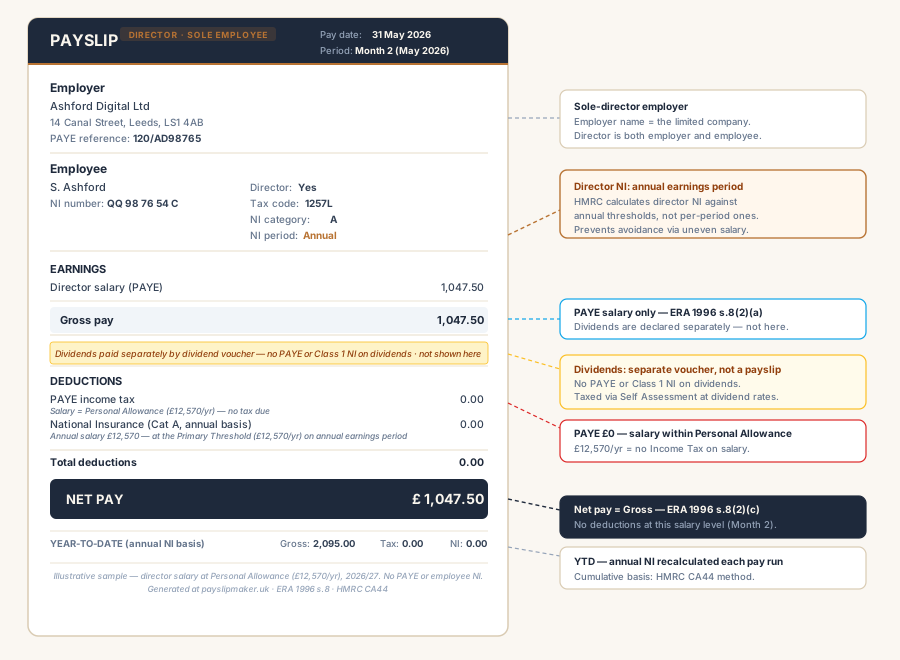
A director’s payslip is legally identical to any other PAYE employee’s payslip. The only difference is that the employer name is your own company. Employment Rights Act 1996 s.8 entitles every PAYE worker to an itemised payslip on or before each pay date. A compliant director’s payslip shows the following fields; those marked s.8 are what the Act mandates — the rest are standard payroll convention.
- Gross earningss.8Your PAYE salary before any deductions. Dividends do not appear here.
- Income Tax (PAYE)s.8Calculated from the tax code HMRC issued — usually 1257L if you have no other income source. s.8 requires the purpose of each deduction to be stated, not just the amount.
- National Insurances.8Employee Class 1 NI at Category A rates. The purpose and amount must be stated. Employer NI is the company's liability and does not appear on the payslip.
- Pension (if applicable)s.8Where a pension contribution is deducted, s.8 requires it itemised with purpose and amount. Auto-enrolment applies to directors only if they have a written employment contract.
- Hours worked (where pay varies by time)s.8Required since April 2019 where pay varies with hours worked — the payslip must state total hours or separate totals at different rates. Directors on a fixed monthly salary need not show hours, but the field is s.8 mandatory where it applies.
- Net pays.8The amount credited to your bank account. Must match the bank entry on the date of payment to the penny — HMRC, lenders, and visa officers all cross-check this.
- Year-to-date totalsRunning gross, tax, and NI totals from 6 April. Payroll convention, not a s.8 requirement, but mortgage underwriters verify these figures across the three months they request.
- Employer nameYour company's registered name. Convention, not s.8 mandatory, but lenders verify it against Companies House. Even as sole director, you are the employer — the company, not you personally, is the legal entity paying the salary.
- Pay periodThe dates the payment covers. Convention. Most director-employees pay monthly, but some choose quarterly or weekly.
FAQ · Director and self-employed payslips
Director and sole-trader payslip questions.
Do self-employed people get payslips in the UK?
Sole traders and partners do not get payslips. They are not employees — they draw profits from a business they own, with no employer to issue a payslip or deduct PAYE. Their proof of income is an SA302 tax calculation and tax-year overview from HMRC. Limited company directors who pay themselves a salary via PAYE are treated as employees of their own company and are entitled to a payslip under section 8 of the Employment Rights Act 1996.
Can a sole trader issue themselves a payslip?
No. A sole trader has no employer-employee relationship. Producing a payslip for sole trader income would misrepresent both the income type (profits, not wages) and the tax treatment (Self Assessment, not PAYE). Lenders and government bodies that accept payslips as proof of income specifically expect PAYE income; presenting a self-produced payslip for sole trader profits will not satisfy them and may raise fraud concerns. The correct documents are your SA302 tax calculation and HMRC tax-year overview for the past two years.
Does a limited company director need to issue themselves a payslip?
Yes, if they take a salary. Under section 8 of the Employment Rights Act 1996, any worker who is paid wages under PAYE must receive an itemised payslip on or before each pay date. A director who is also an employee of their limited company, and who pays themselves a PAYE salary through the company, must issue themselves a payslip for that salary — even if they are the sole director and the only employee. Directors who take only dividends do not need a payslip for the dividend portion.
What is the difference between a payslip and an SA302?
A payslip is a real-time record of a single pay period — it shows gross salary, PAYE deducted, National Insurance, pension, and net pay. An SA302 is an annual HMRC tax calculation produced after you file a Self Assessment return; it shows total income from all sources for a full tax year and the tax owed or refunded. Payslips are for PAYE employees (including directors on salary). SA302s are for anyone with Self Assessment income — the mandatory document for sole traders, freelancers, and landlords proving income to lenders or the Home Office.
Can a director issue their own payslip using this generator?
Yes. If you are both the director and the sole employee of your limited company, you are the employer. You decide the salary, you run the payroll, and you issue the payslip. This generator calculates PAYE, National Insurance (Category A or M), pension, and student loan deductions on 2026/27 HMRC rates and produces a clean PDF. The figures you enter must match the salary actually paid and reconcile to the credit on your bank statement — the same reconciliation check that HMRC, lenders, and visa officers use.
What National Insurance category applies to a limited company director?
Most limited company directors fall into NI Category A (standard rate, applicable to employees over 21 who do not qualify for a reduced category). Category M applies to employees under 21. Category C applies to employees who have reached State Pension age and therefore pay no employee NI contributions. Directors who are also the company secretary or hold another PAYE role use the same category as any other employee. There is no separate "director" NI category — the standard employee categories apply to the salary portion of a director's remuneration.
What proof of income can a sole trader provide instead of a payslip?
The two documents HMRC produces that lenders and the Home Office accept as proof of income for sole traders are: (1) the SA302 tax calculation — available from your HMRC personal tax account or online Self Assessment account, showing total income and tax for a full tax year; and (2) the tax-year overview — a summary page confirming the tax due or paid. Most UK mortgage lenders require two complete tax years of SA302s and tax-year overviews for self-employed applicants. Some also ask for business bank statements or audited accounts.
Can a director use their payslip as proof of income for a mortgage?
Yes, for the PAYE salary portion. UK mortgage lenders treat limited company directors the same as employees for the salary line — they ask for three months of payslips, and the net pay on each slip must reconcile to the credit on your bank statement. For the dividend portion of a director's income, lenders ask for two years of company accounts and SA302s instead. Some lenders average the salary and dividend income across two years; others take the lower of the two years. A broker who specialises in self-employed and director mortgages will identify which lenders are most favourable.
I work through an umbrella company — do I generate my own payslip?
No. Workers employed through an umbrella company are employees of the umbrella, not of their own limited company. The umbrella runs PAYE, files a Full Payment Submission with HMRC for each payroll run, and issues the payslip for that period. The same applies to agency PAYE workers and to engagements caught inside IR35, where the fee-payer or umbrella is the employer of record. Self-generating a payslip would duplicate — and likely contradict — the payslip your umbrella or fee-payer has already filed with HMRC.