Quotation before the work, invoice on supply, receipt when payment clears. Each covers one event and does not substitute for the others; the common confusion costs the customer because a document HMRC reads as a receipt cannot be used to reclaim input VAT.
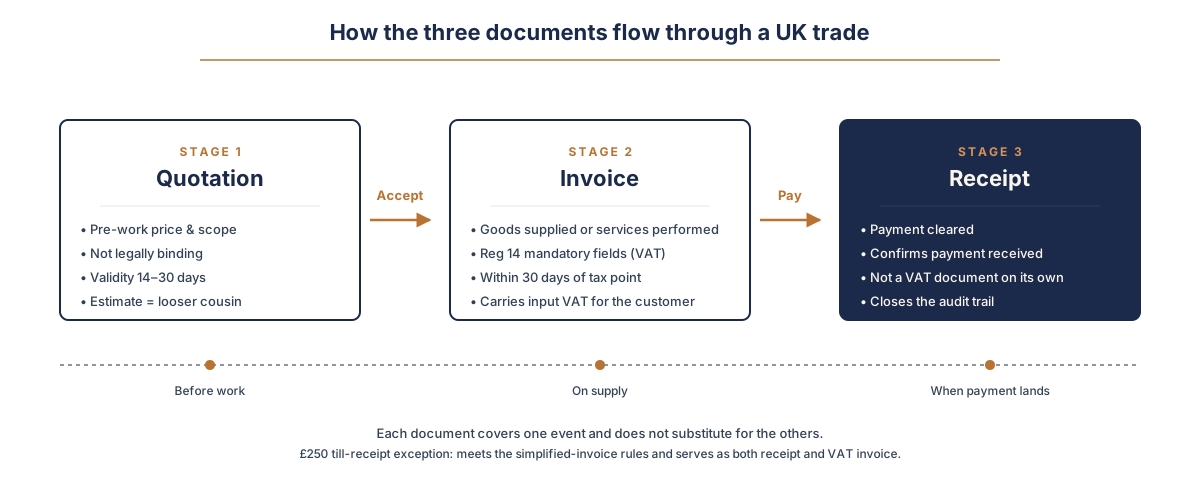
Quotation vs invoice vs receipt at a glance
| Quotation | Invoice | Receipt | |
|---|---|---|---|
| When it is issued | Before the work or supply | Once goods supplied or services performed | When payment clears |
| What it does | Offers a price and scope; binds nobody until accepted | Demands payment for a defined supply | Confirms payment received |
| Statutory format | None | Regulation 14, VAT Regulations 1995 for VAT-registered suppliers | None |
| VAT-relevant? | No | Yes: input VAT recovery flows from the invoice | No on its own (supports the audit trail) |
| Issuance window | Validity often 14 to 30 days | Within 30 days of the tax point | On request when payment lands |
| What it proves | Agreed scope and price | VAT declared or reclaimable | Payment was made |
What about the £250 simplified-invoice exception?
For retail sales of £250 or less including VAT, the simplified-invoice rules let the supplier drop the customer name and address and skip a separate VAT breakdown. The till receipt at a supermarket meets this standard and functions as both receipt and VAT invoice. For sales above £250 the till receipt alone is not enough; the supplier must issue a full invoice on request. The full Regulation 14 checklist covers the threshold edge cases.
How does HMRC read these in an enquiry?
Invoices verify output VAT declared on the supplier side and input VAT reclaimed on the customer side. Receipts corroborate that the invoice was paid; bank-statement evidence is preferred, with receipts closing the loop on cash transactions. Quotations rarely surface unless a dispute exists about scope or price. Records under VAT Notice 700 and Companies Act 2006 section 388 form the basis of the audit trail.
In 6 steps
How to Choose Between a UK Quotation, Invoice, and Receipt
Pick the right document at each stage of a UK supply: quotation before work begins, invoice on supply, receipt on payment. Apply Regulation 14 to the invoice, keep retention to the 5-year sole-trader and 6-year company windows.
- 1
Identify where you are in the supply sequence
Before any work or supply happens, you are at the quotation stage. Once goods are supplied or services performed, you are at the invoice stage. Once payment lands, you are at the receipt stage. Each document covers one event and does not substitute for the others.
- 2
Issue a quotation for the pre-work price
State the price, scope, and validity window (commonly 14 to 30 days). Make clear whether the figure is net or gross of VAT. A quotation is not a tax document and carries no statutory format. It becomes a contract when the customer accepts it.
- 3
Issue a Regulation 14 VAT invoice on supply
For VAT-registered suppliers, a full invoice carries eleven fields: unique sequential number, date, supplier name and VAT number, customer name, supply description, line items with rates and net amounts, total VAT in sterling, gross total. Issue within 30 days of the tax point unless HMRC has agreed a longer period.
- 4
Use the simplified-invoice rules for retail sales £250 or less
For retail sales of £250 or less including VAT, the simplified invoice drops the customer name and address and allows the VAT-inclusive total without a separate breakdown. The till receipt at a supermarket checkout meets this standard. For sales above £250, the supplier must issue a full invoice on request.
- 5
Issue a receipt when payment lands
Show date of payment, amount, method (cash, card, bank reference, cheque), what the payment was for (the invoice number it settles), supplier name, and a unique receipt number. A receipt is not by itself a VAT document, so customers reclaiming input VAT still need the invoice.
- 6
Retain all three for the right window
Sole traders keep records for 5 years after the 31 January Self Assessment deadline. Limited companies keep records for 6 years from the end of the financial year under section 388 of the Companies Act 2006. VAT-registered businesses keep VAT records for 6 years. Inadequate records on a Compliance Check trigger penalties under FA 2008 Schedule 41.
Primary sources
- VAT Regulations 1995, Regulation 14 — legislation.gov.uk — Mandatory contents of a VAT invoice and the simplified-invoice exception
- VAT record keeping: VAT invoices — gov.uk — HMRC plain-English guidance on full, simplified, and modified invoices
- VAT Notice 700: the VAT guide — gov.uk — General VAT framework including time of supply and invoice timing
- Companies Act 2006, Section 388 — legislation.gov.uk — Duty to keep adequate accounting records and retention periods
- Business records if you are self-employed — gov.uk — HMRC record-keeping rules for sole traders and partnerships
Editorial process: how we source and review UK tax content.